Compare KDP trim sizes for paperback and hardcover books, then choose the right Amazon book dimensions by genre, page count, format, and reading feel.
The best KDP trim size is not simply the largest size Amazon allows. It is the size that fits the way your book will be read, gives the interior enough room, produces the page count you want, and works for every print format you plan to publish.
For many text-heavy paperbacks in the U.S., 6 x 9 inches is the most familiar starting point. Amazon KDP identifies it as the most common U.S. trim size. But a compact novel may feel better at 5 x 8 or 5.5 x 8.5, while a workbook, manual, or image-heavy book may need 7 x 10 or 8.5 x 11.
Use this guide in two stages:
Those are different decisions. A 6 x 9 trim size describes one finished page. It does not describe the full paperback cover file you upload to KDP.
Start with the row that sounds most like your book, then compare it with physical books in the same category.
| Book type | Useful starting sizes | Why authors consider them |
|---|
| Novels, memoirs, poetry | 5 x 8, 5.5 x 8.5, 6 x 9 | Familiar reading proportions, with a choice between compact and more spacious pages |
| General nonfiction | 5.5 x 8.5, 6 x 9 | Enough room for headings and tables without immediately feeling like a workbook |
| Business books and practical guides | 6 x 9, 7 x 10 | More room for subheadings, examples, diagrams, and callouts |
| Workbooks, manuals, and textbooks | 7 x 10, 8 x 10, 8.5 x 11 | Wider pages support exercises, tables, screenshots, and writing space |
| Children's and illustration-heavy books | Square or larger portrait sizes, depending on the art | The page must serve the illustrations, text size, and reading age |
| Journals, planners, and activity books | 6 x 9, 7 x 10, 8.5 x 11 | The right choice depends on how much room the reader needs to write or draw |
These are decision aids, not KDP rules or genre guarantees. Before committing, place a sample chapter into two candidate sizes. Compare the page count, line length, margins, image scale, and how the book feels in your hand.
Trim size is the width and height of the finished printed page after manufacturing. KDP lists dimensions as width by height, so 6 x 9 means a page that is 6 inches wide and 9 inches tall.
This guide is about paperback and hardcover dimensions. A reflowable eBook does not have a fixed trim size because its text adapts to the reader's device and settings. Its cover is a front-cover image with pixel requirements, not a physical page measurement.
Trim size affects more than appearance:
KDP considers a book a large trim size when it is wider than 6.12 inches or taller than 9 inches. That includes common options such as 7 x 10 and 8.5 x 11.
The table below lists KDP's preset paperback trim sizes for the U.S. marketplace. KDP also allows custom paperback trim sizes within its supported range, but preset sizes are easier to compare with templates and common publishing conventions.
| Paperback trim size | Centimeters | KDP class |
|---|---|---|
5 x 8 in | 12.7 x 20.32 cm | Regular |
5.06 x 7.81 in | 12.85 x 19.84 cm | Regular |
5.25 x 8 in | 13.34 x 20.32 cm | Regular |
5.5 x 8.5 in | 13.97 x 21.59 cm | Regular |
6 x 9 in | 15.24 x 22.86 cm | Regular |
6.14 x 9.21 in | 15.6 x 23.39 cm | Large |
6.69 x 9.61 in | 16.99 x 24.41 cm | Large |
7 x 10 in | 17.78 x 25.4 cm | Large |
7.44 x 9.69 in | 18.9 x 24.61 cm | Large |
7.5 x 9.25 in | 19.05 x 23.5 cm | Large |
8 x 10 in | 20.32 x 25.4 cm | Large |
8.25 x 6 in | 20.96 x 15.24 cm | Large, landscape |
8.25 x 8.25 in | 20.96 x 20.96 cm | Large, square |
8.5 x 8.5 in | 21.59 x 21.59 cm | Large, square |
8.5 x 11 in | 21.59 x 27.94 cm | Large |
8.27 x 11.69 in | 21 x 29.7 cm | Large |
Page-count limits are not one fixed number for every paperback. They vary by trim size, ink, and paper type. For example, the upper limit for a black-ink paperback may differ from the limit for a standard-color interior at the same trim size. Check KDP's current Set Trim Size, Bleed, and Margins table against your exact print settings before locking the interior.
KDP currently permits custom paperback trim sizes between 4 and 8.5 inches wide and 6 and 11.69 inches high. A custom size can solve a specific production need, but it also gives you fewer familiar comparison points. Use one because the book needs it, not only because it is available.
KDP hardcover options are more limited than paperback options.
| Hardcover trim size | Centimeters | KDP class |
|---|---|---|
5.5 x 8.5 in | 13.97 x 21.59 cm | Regular |
6 x 9 in | 15.24 x 22.86 cm | Regular |
6.14 x 9.21 in | 15.6 x 23.39 cm | Large |
7 x 10 in | 17.78 x 25.4 cm | Large |
8.25 x 11 in | 20.96 x 27.94 cm | Large |
KDP's current U.S. specifications list 75 to 550 pages for these hardcover sizes with supported black-and-white or premium-color interiors. Standard color and groundwood paper are not available for hardcover in the current table.
If you plan to release both paperback and hardcover, choose from the shared sizes unless you have a reason to create separate interiors. The shared presets are 5.5 x 8.5, 6 x 9, 6.14 x 9.21, 7 x 10, and 8.25 x 11.
Using the same trim size can simplify interior formatting. It does not let the two formats share one cover file: paperback and hardcover covers have different structures and must be calculated separately.
A specification table tells you what KDP can print. It does not tell you what your book should feel like. These comparisons turn the numbers into practical choices.
5 x 8 is useful for a compact paperback. It can suit novels, poetry, short memoirs, and books where portability matters.
The tradeoff is interior space. Long headings, tables, wide images, and generous margins are harder to fit. The same manuscript will usually run to more pages than it would at 6 x 9, which can increase spine width and affect printing cost.
KDP does not offer 5 x 8 as a hardcover preset. If matching paperback and hardcover dimensions matters, compare 5.5 x 8.5 and 6 x 9 instead.
5.5 x 8.5 sits between compact paperback proportions and the roomier 6 x 9 format. It is a useful candidate for fiction, memoir, narrative nonfiction, and other mostly text-based books.
It is also the smallest preset shared by KDP paperback and hardcover. That makes it worth testing when you want the two editions to feel related without moving all the way to 6 x 9.
KDP identifies 6 x 9 as the most common trim size for U.S. books. It works as a starting point for novels, memoirs, general nonfiction, business books, and many instructional titles.
Its advantage is balance: it gives text and headings more room than smaller trade sizes while remaining familiar and portable. It also works for both paperback and hardcover.
But “most common” does not mean “best for every book.” A short novel may look thin or feel oversized at 6 x 9. A workbook with large diagrams may still feel cramped.
7 x 10 can work well for practical nonfiction, manuals, textbooks, workbooks, and books with frequent tables or diagrams. The wider page supports more complex layouts without reaching full letter size.
It is a large trim size, so check current printing costs. Also compare it with similar books: a roomy layout can improve usability, but it can make a simple text-only book feel larger than readers expect.
8.5 x 11 is useful when the page itself is a working surface: worksheets, activity pages, manuals, educational material, forms, and large illustrations.
It is a paperback preset, not a KDP hardcover preset. The closest large hardcover preset is 8.25 x 11.
At this size, cover composition matters. A cover designed like a compact novel can look empty when stretched to a tall, wide page. The interior also needs enough content or writing space to justify the format.
These three sizes cause the most hesitation for text-heavy books. Use the manuscript, not habit, to decide.
| Question | 5 x 8 | 5.5 x 8.5 | 6 x 9 |
|---|---|---|---|
| Physical feel | Most compact | Compact but roomier | Largest and most spacious of the three |
| Text per page | Least | Middle | Most |
| Likely page count for the same layout | Highest | Middle | Lowest |
| KDP hardcover preset | No | Yes | Yes |
| Useful starting point for | Compact novels, poetry, short books | Fiction, memoir, narrative nonfiction | General nonfiction, business, longer text-heavy books |
| Main risk | Cramped pages or high page count | May still be tight for complex layouts | A short or intimate book may feel oversized |
Create a real sample before deciding:
The printed sample usually answers questions a screen cannot: whether the text block feels crowded, whether the page is comfortable to hold, and whether the format resembles books your audience already buys.
Changing trim size changes the production system around the book.
A smaller page holds less text, so the manuscript may gain pages. A larger page may reduce page count. Because page count and paper type affect spine width, the full cover must be recalculated after the interior is final. If you want to understand or verify that calculation, use the KDP spine width formula with your final page count and paper type.
KDP's minimum inside margin increases with page count. The typeface, font size, leading, paragraph spacing, and outside margins also shape the reading experience. Do not resize the page and leave every other setting untouched.
KDP separates regular and large trim sizes, and printing cost can change with trim size, page count, marketplace, ink, and paper. Use KDP's current pricing tools before making a cost-sensitive decision.
Paperback offers more preset sizes and allows supported custom sizes. Hardcover offers five presets in the current U.S. table. If you want both formats, decide early whether they must share a trim size.
A taller or wider trim size changes the front-cover canvas. Title scale, focal image, borders, and genre signals may need a different composition. A design that works at 5 x 8 should be reviewed, not simply stretched, at 8.5 x 11.
For a print book, the trim size describes the finished page and each front or back cover panel. The uploaded full cover also includes the back cover, spine, front cover, and bleed.
The KDP full wrap cover guide explains how those measurements become one back-spine-front cover file.
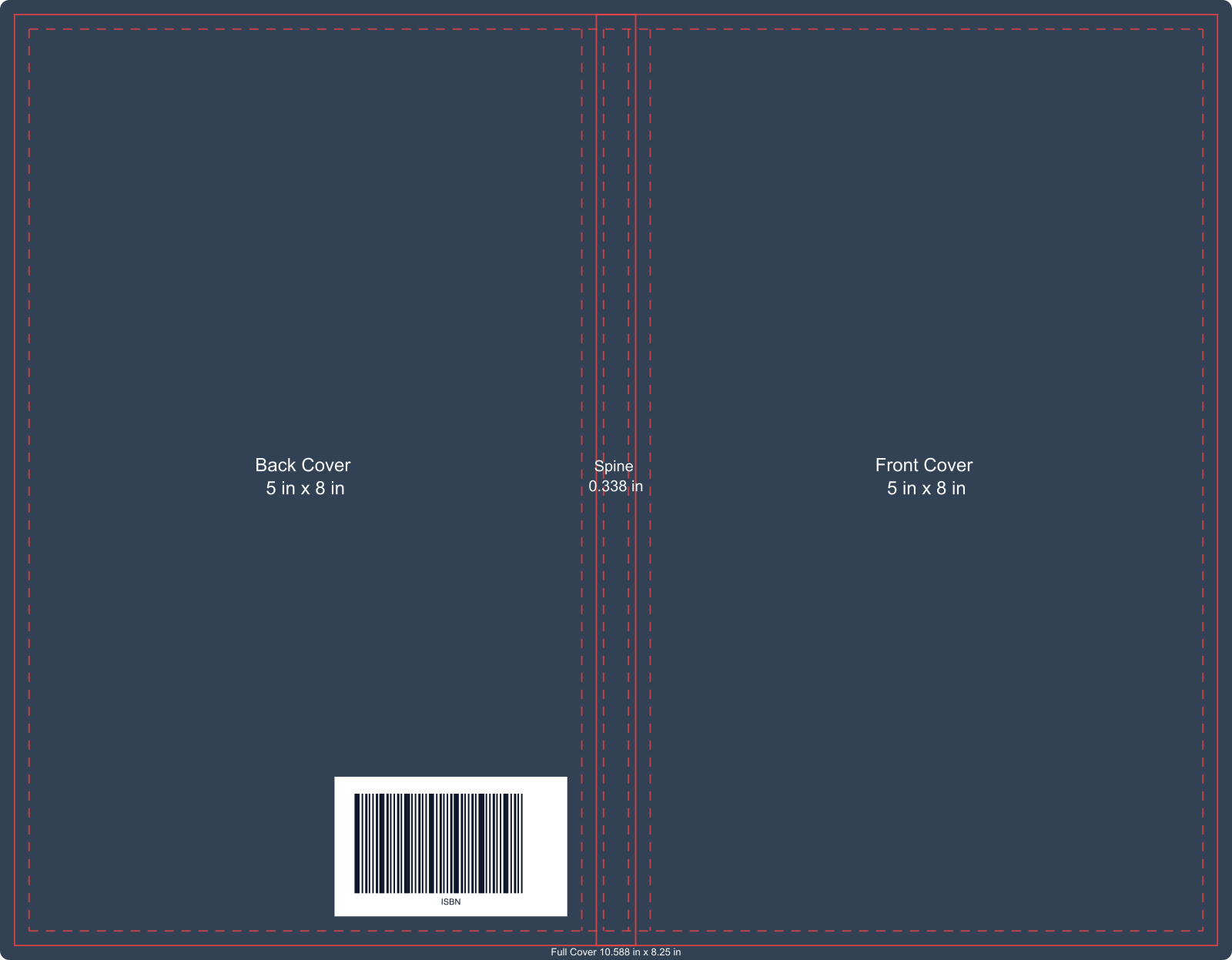
This example shows a 5 x 8 paperback with 150 white-paper pages. The finished panels are each 5 x 8, but the full cover is 10.588 x 8.25 because it includes a 0.338-inch spine and outside bleed.
Do not calculate the final cover while the manuscript page count is still moving. First lock the trim size and finish the interior. Then use the KDP Cover Size Calculator to calculate the full cover width, height, spine, bleed, safe areas, and barcode reserve for the current format.
KDP lists trim size as a print-book detail that cannot be changed after publication. Changing it means publishing a new edition, so resolve the physical size before you treat the interior and cover as final.
Before you lock the interior, answer these questions:
If two sizes still seem reasonable, choose the one that makes the reading task easier. Do not choose only from the number of pages or from a generic “most popular” label.
Use this order to avoid rebuilding the cover more than once:
If you already have an eBook or front-cover image, the Ebook to KDP Paperback Cover Converter can help you build the paperback wrap after the trim size and page count are ready.
If you still need cover artwork for that trim size, use the KDP Book Cover Generator to create a full KDP cover around the chosen format and final print settings.
The result should be one locked trim size, a finished interior, and a cover built from the final book settings—not a cover guessed from trim size alone.